
For more than 25 years, the Feline Conservation Foundation has been committed to protecting wild felids through targeted conservation, education, and research. To date, FCF has donated over $100,000 to conservation grants and field-based projects across the globe, with a strong emphasis on wild cats that receive limited attention, funding, or media coverage.
Today, our conservation strategy is more intentional than ever. Rather than one-off grants, FCF prioritizes long-term partnerships that allow us to measure impact, track outcomes over time, and ensure that donor support results in meaningful, lasting conservation gains.
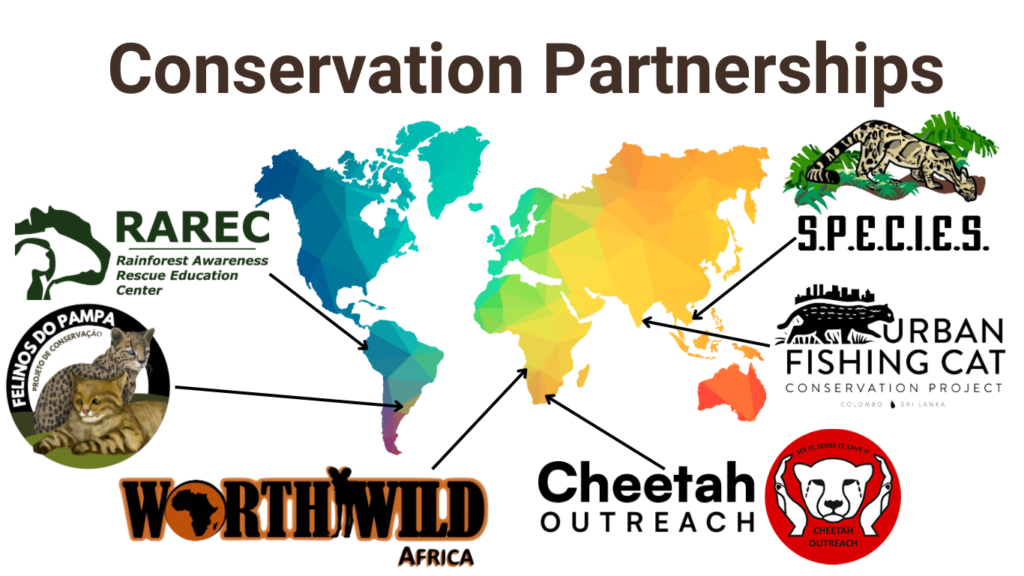
All FCF conservation partners are carefully selected to align with our mission and values. We proudly support projects that:
• Focus on under-represented wild felid species
• Integrate science, education, and community engagement
• Recognize the vital role of zoological facilities and animals under human care, as much of our fundraising comes from zoos giving back to their wild counterparts
Felinos Do Pampa – Southern Brazil (Pampa Biome)
One of FCF’s flagship conservation partnerships supports a Felinos Do Pampa operating in Rio Grande do Sul, Brazil, a global hotspot for wild felid diversity. This region contains eight species of wild cats, including six small cat species and two large cats, and represents a critical transition zone between the Atlantic Forest and the Pampa biome.
The primary objective of this program is to reduce conflict between humans and wild cats, a leading cause of mortality for small felids in the region.
Focus Areas
• Retaliatory hunting linked to poultry and livestock predation
• Negative interactions between wild cats and free-roaming domestic dogs
• Community-based education and conflict mitigation
2025 Priorities
In 2025, the program aims to expand its reach by:
• Increasing support to farmers experiencing livestock losses, including compensation, husbandry assistance, and structural improvements to henhouses and animal enclosures
• Expanding environmental education through school visits, community events, and educational materials focused on wild cat conservation
• Launching a domestic dog neuter and management program to reduce roaming, disease transmission, and predation pressure on wild cat populations
This dog-focused initiative is a critical new priority, addressing one of the most urgent and overlooked threats to wild cats in the region.
Why This Work Matters
Rio Grande do Sul is home to several species of conservation concern, including:
• Munõa’s Pampas cat, endemic to the region and classified as Critically Endangered
• Southern tiger cat, listed as Vulnerable
While some species are not globally threatened, all wild cats in this region face extinction risk locally due to habitat fragmentation, urban expansion, and agricultural conversion. Encouragingly, increased requests from farmers seeking non-lethal solutions demonstrate growing trust in conservation-based conflict resolution.
Rainforest Awareness Rescue & Education Center (RAREC) – Peru

Rainforest Awareness Rescue Education Center (RAREC) is a registered 501(c)(3) non-profit located near Iquitos, Peru, in the heart of the Amazon Rainforest.
Founded in 2011, RAREC rescues, rehabilitates, and releases wildlife impacted by illegal hunting, poaching, and deforestation. Working closely with the Peruvian Environmental Police, the center has cared for a wide range of species, including:
• Ocelots
• Manatees
• Tapirs
• Anteaters
• Sloths
• Giant river otters
• Spider and woolly monkeys
Animals that cannot be safely returned to the wild due to physical or behavioral limitations are provided with lifelong care at the center. RAREC also plays a vital role in educating local communities, helping families develop sustainable livelihoods that reduce pressure on rainforest ecosystems.
Worth Wild Africa – Black-Footed Cat Project (Mpumalanga, Africa)

Worth Wild Africa (WWA) is advancing research on black-footed cats in South Africa’s Mpumalanga Province through an adaptive, data-driven conservation approach.
The project has completed multiple pilot surveys, established local feedback groups, and refined its strategy to reflect the diverse landscapes and conservation challenges identified in the field. Mpumalanga has historically been an under-studied region, and early findings have provided valuable insights while also highlighting key challenges—particularly the need for improved technical equipment to support expanded research and long-term monitoring.
Current data indicates that Mpumalanga supports a wider and more continuous distribution of black-footed cats than previously understood, including records at elevations up to 1,700 meters above sea level. These discoveries are reshaping understanding of the species’ range and habitat use.
As the project moves forward, WWA is focused on strengthening partnerships and expanding capacity to develop a robust, long-term conservation strategy for this elusive and underfunded species.
S.P.E.C.I.E.S. & Project Neofelis – Clouded Leopard Conservation
S.P.E.C.I.E.S. (Society for the Preservation of Endangered Carnivores and their International Ecological Study) works globally to conserve carnivore populations through integrated science, education, community engagement, and policy.
Project Neofelis
Project Neofelis focuses on the conservation of clouded leopards, a species that has been consistently overlooked in favor of more charismatic megafauna such as tigers and elephants. Despite facing intense threats from deforestation, palm oil production, and illegal wildlife trade, clouded leopards receive only a fraction of the conservation attention given to larger cats.
Project goals include:
• Using camera-trap bycatch data to inform conservation planning
• Conducting population surveys across the species’ range
• Building international collaboration among conservation stakeholders
• Elevating clouded leopards as a flagship species to raise awareness for other small, endangered Asian felids
Urban Fishing Cat Conservation – Sri Lanka
The Fishing Cat Conservation Project is dedicated to protecting fishing cats and the wetland ecosystems they depend on throughout Sri Lanka. Through research, community engagement, and conservation action, the project works to ensure the survival of this unique wild cat while promoting coexistence between people and wildlife.
A flagship initiative of the program is the Urban Fishing Cat Project, which studies and protects fishing cats living in and around cities and human-dominated landscapes. By using camera traps, GPS tracking, citizen science, and public education, researchers are gaining valuable insights into how fishing cats navigate urban environments and the challenges they face from habitat loss, road mortality, and human-wildlife conflict. Through science-based conservation and community partnerships, the Fishing Cat Conservation Project is helping secure a future for one of the world’s most remarkable wetland predators.
Cheetah Outreach Trust

The Cheetah Outreach Trust is dedicated to securing a future for South Africa’s free-ranging cheetahs through research, education, and community-based conservation. Working across key cheetah habitats, the organization develops practical solutions that allow farmers, local communities, and wildlife to coexist while protecting one of Africa’s most iconic predators.
Through conservation initiatives, livestock protection programs, and public awareness campaigns, the Trust helps reduce human-wildlife conflict and supports the long-term survival of cheetahs on private and communal lands. By engaging both local and international partners, Cheetah Outreach promotes science-based conservation strategies that protect wild cheetah populations and the ecosystems they depend upon for future generations.
This project began after extensive wetland loss in Colombo, Sri Lanka, where researchers discovered fishing cats living entirely within the city—using abandoned buildings, garden ponds, and drainage systems to survive. Through camera trapping, GPS collaring, and close collaboration with government agencies, the fishing cat has become a flagship species for urban wetland conservation, driving policy discussions and habitat protection efforts.
Our Commitment
Across all of our conservation initiatives, FCF is committed to:
• Supporting underfunded wild felid species
• Investing in long-term, measurable conservation outcomes
• Bridging the gap between zoos, field conservation, and local communities
• Ensuring that animals under human care actively contribute to the survival of their wild counterparts
Every partnership we support reflects our belief that effective conservation begins with collaboration—and lasts through commitment.